Plum Blossom Tokoname Japanese Teapot by Shoryu (9oz/270ml)
Why We Love It
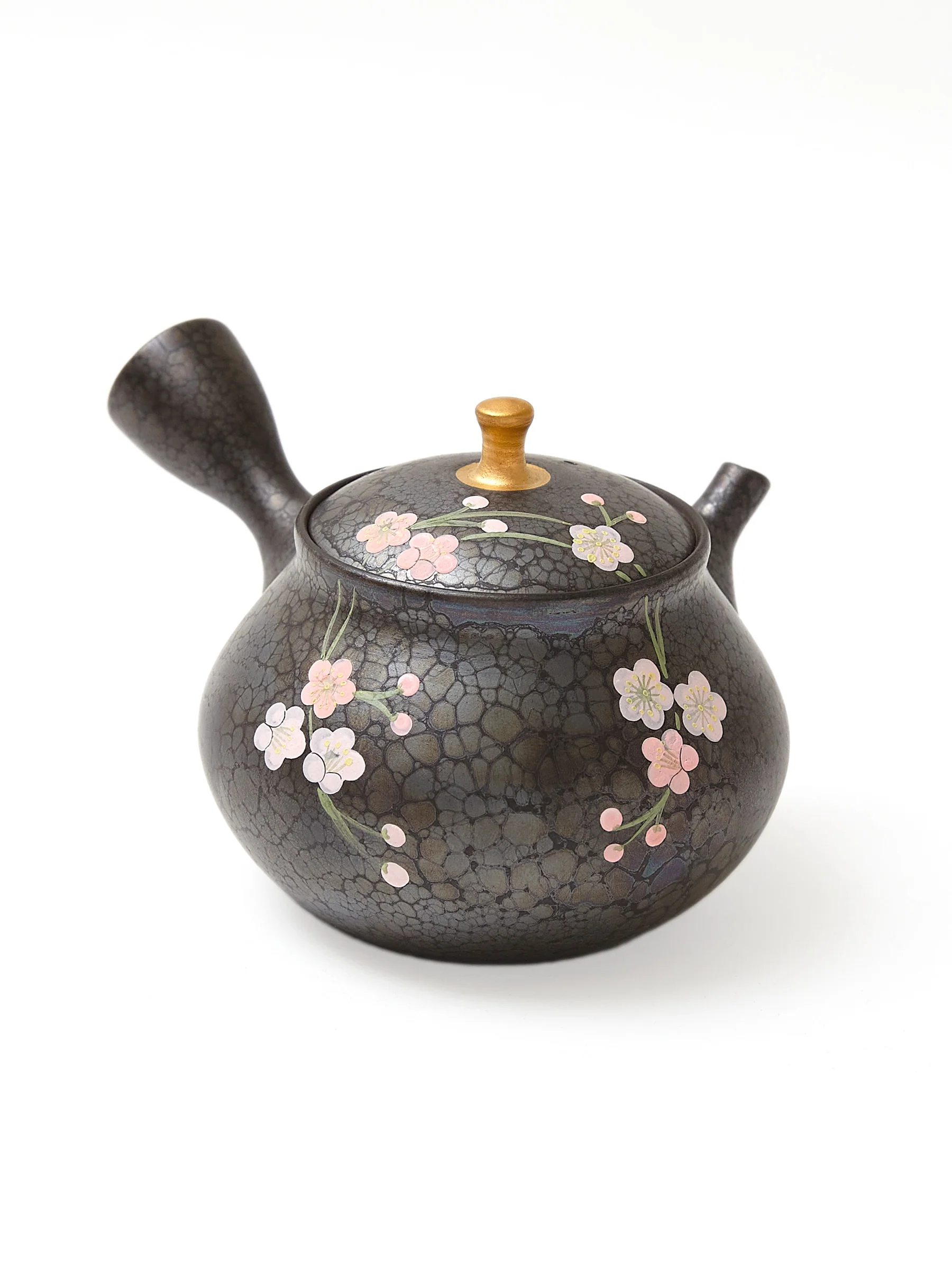
This Kyusu Teapot (9.8oz/280ml) features exquisitely hand-painted plum blossom. The teapot is made of red Tokoname clay and has turned black due to reduction firing. Tenmoku glaze is the specialty of Shoryu Kiln: teapots are glazed with a special technique called yuteki (“oil drops”). Every teapot is unique and was fired five times: when the clay teapot was still red; then, to set the hand-painted flower; to add the oil drops glazing on the surface; to change the teapot’s color into black (reduction firing) and finally, to apply melted pure gold on the lid knob.
This teapot features a semi-handmade ceramic strainer, named sasame. Developed in Tokoname and made of clay, this filter has numerous tiny holes on its surface. The filter’s shape is manufactured by the artist, and the holes are made by using a special tool (puncher).
The tea leaves have room to spread in hot water, bringing the original taste and aroma of the tea. This traditional strainer can also be used with very fine tea leaves, such as deep-steamed tea (fukamushi sencha) but must be carefully cleaned to avoid clogging. It works perfectly with larger or curled tea leaves, such as tamaryokucha.
This teapot is suitable for any types of tea. Sencha (middle- to high-grade green tea) and kariganecha (high-grade stem tea) are especially recommended.
Why Choose a Teapot from Tokoname
Tokoname teapots and teacups are lightweight, resistant, smooth, and particularly easy to use. Green tea enthusiasts swear by the taste that Tokoname clay imparts to the tea. It is said that the iron contained in Tokoname clay softens the astringency and adds roundness to Japanese green tea. Moreover, Tokoname teapots take on a patina over time: the tea brewed in these kyusu gains in quality. Each teapot is fired with its lid placed on. Consequently, the lids are extremely airtight.
Tokoname-yaki ware is produced in the area around the town of Tokoname, in Aichi prefecture, and is one of the Six Ancient Kilns of Japan. Tokoname is the center of teapot production in Japan: nowadays, there are numerous kilns in activity, with artisans still pursuing traditional techniques.
This teapot is handcrafted by Shoryu Kiln. Born in 1945, the potter Shoryu has been creating tea ware for more than 60 years. He even developed his own light clay, after years of research and development. In 2018, he received the Order of the Sacred Treasure, Silver Rays, from the Japanese government for his notable contribution to the country’s traditional crafts.
Caring For Your Kyusu Teapot
After use, the teapot should be rinsed thoroughly with hot water, which will help it to dry faster. Store in a well-ventilated area, and do not replace the lid before the inside is completely dry. Pay attention to the interior of the spout, which remains wet for a long time.
Details
- Kyusu Teapot
- Handmade in Japan
- Free gift-wrapping in Japanese furoshiki cloth
- Handpainted design over yuteki (“oil drops”) glaze
- As each handmade product is unique, there may be small differences in size, color and pattern from the photographs above.
- Size: ⌀ 3.1” (8cm), width 5.1” (13cm), height 3.1” (8cm)
- Capacity: 9.8oz (280ml)
- Code: 94704BK
Why We Love It
This Kyusu Teapot (9.8oz/280ml) features exquisitely hand-painted plum blossom. The teapot is made of red Tokoname clay and has turned black due to reduction firing. Tenmoku glaze is the specialty of Shoryu Kiln: teapots are glazed with a special technique called yuteki (“oil drops”). Every teapot is unique and was fired five times: when the clay teapot was still red; then, to set the hand-painted flower; to add the oil drops glazing on the surface; to change the teapot’s color into black (reduction firing) and finally, to apply melted pure gold on the lid knob.
This teapot features a semi-handmade ceramic strainer, named sasame. Developed in Tokoname and made of clay, this filter has numerous tiny holes on its surface. The filter’s shape is manufactured by the artist, and the holes are made by using a special tool (puncher).
The tea leaves have room to spread in hot water, bringing the original taste and aroma of the tea. This traditional strainer can also be used with very fine tea leaves, such as deep-steamed tea (fukamushi sencha) but must be carefully cleaned to avoid clogging. It works perfectly with larger or curled tea leaves, such as tamaryokucha.
This teapot is suitable for any types of tea. Sencha (middle- to high-grade green tea) and kariganecha (high-grade stem tea) are especially recommended.
Why Choose a Teapot from Tokoname
Tokoname teapots and teacups are lightweight, resistant, smooth, and particularly easy to use. Green tea enthusiasts swear by the taste that Tokoname clay imparts to the tea. It is said that the iron contained in Tokoname clay softens the astringency and adds roundness to Japanese green tea. Moreover, Tokoname teapots take on a patina over time: the tea brewed in these kyusu gains in quality. Each teapot is fired with its lid placed on. Consequently, the lids are extremely airtight.
Tokoname-yaki ware is produced in the area around the town of Tokoname, in Aichi prefecture, and is one of the Six Ancient Kilns of Japan. Tokoname is the center of teapot production in Japan: nowadays, there are numerous kilns in activity, with artisans still pursuing traditional techniques.
This teapot is handcrafted by Shoryu Kiln. Born in 1945, the potter Shoryu has been creating tea ware for more than 60 years. He even developed his own light clay, after years of research and development. In 2018, he received the Order of the Sacred Treasure, Silver Rays, from the Japanese government for his notable contribution to the country’s traditional crafts.
Caring For Your Kyusu Teapot
After use, the teapot should be rinsed thoroughly with hot water, which will help it to dry faster. Store in a well-ventilated area, and do not replace the lid before the inside is completely dry. Pay attention to the interior of the spout, which remains wet for a long time.
Details
- Kyusu Teapot
- Handmade in Japan
- Free gift-wrapping in Japanese furoshiki cloth
- Handpainted design over yuteki (“oil drops”) glaze
- As each handmade product is unique, there may be small differences in size, color and pattern from the photographs above.
- Size: ⌀ 3.1” (8cm), width 5.1” (13cm), height 3.1” (8cm)
- Capacity: 9.8oz (280ml)
- Code: 94704BK
Original: $108,500.00
-70%$108,500.00
$32,550.00Description
Why We Love It
This Kyusu Teapot (9.8oz/280ml) features exquisitely hand-painted plum blossom. The teapot is made of red Tokoname clay and has turned black due to reduction firing. Tenmoku glaze is the specialty of Shoryu Kiln: teapots are glazed with a special technique called yuteki (“oil drops”). Every teapot is unique and was fired five times: when the clay teapot was still red; then, to set the hand-painted flower; to add the oil drops glazing on the surface; to change the teapot’s color into black (reduction firing) and finally, to apply melted pure gold on the lid knob.
This teapot features a semi-handmade ceramic strainer, named sasame. Developed in Tokoname and made of clay, this filter has numerous tiny holes on its surface. The filter’s shape is manufactured by the artist, and the holes are made by using a special tool (puncher).
The tea leaves have room to spread in hot water, bringing the original taste and aroma of the tea. This traditional strainer can also be used with very fine tea leaves, such as deep-steamed tea (fukamushi sencha) but must be carefully cleaned to avoid clogging. It works perfectly with larger or curled tea leaves, such as tamaryokucha.
This teapot is suitable for any types of tea. Sencha (middle- to high-grade green tea) and kariganecha (high-grade stem tea) are especially recommended.
Why Choose a Teapot from Tokoname
Tokoname teapots and teacups are lightweight, resistant, smooth, and particularly easy to use. Green tea enthusiasts swear by the taste that Tokoname clay imparts to the tea. It is said that the iron contained in Tokoname clay softens the astringency and adds roundness to Japanese green tea. Moreover, Tokoname teapots take on a patina over time: the tea brewed in these kyusu gains in quality. Each teapot is fired with its lid placed on. Consequently, the lids are extremely airtight.
Tokoname-yaki ware is produced in the area around the town of Tokoname, in Aichi prefecture, and is one of the Six Ancient Kilns of Japan. Tokoname is the center of teapot production in Japan: nowadays, there are numerous kilns in activity, with artisans still pursuing traditional techniques.
This teapot is handcrafted by Shoryu Kiln. Born in 1945, the potter Shoryu has been creating tea ware for more than 60 years. He even developed his own light clay, after years of research and development. In 2018, he received the Order of the Sacred Treasure, Silver Rays, from the Japanese government for his notable contribution to the country’s traditional crafts.
Caring For Your Kyusu Teapot
After use, the teapot should be rinsed thoroughly with hot water, which will help it to dry faster. Store in a well-ventilated area, and do not replace the lid before the inside is completely dry. Pay attention to the interior of the spout, which remains wet for a long time.
Details
- Kyusu Teapot
- Handmade in Japan
- Free gift-wrapping in Japanese furoshiki cloth
- Handpainted design over yuteki (“oil drops”) glaze
- As each handmade product is unique, there may be small differences in size, color and pattern from the photographs above.
- Size: ⌀ 3.1” (8cm), width 5.1” (13cm), height 3.1” (8cm)
- Capacity: 9.8oz (280ml)
- Code: 94704BK